Clinical research is the study of health and illness in people. There are two main types of clinical research: observationalstudies and clinical trials.
Observational studies monitor people in normal settings. Researchers gather information from people and compare changes over time. For example, researchers may ask a group of older adults about their exercise habits and provide monthly memory tests for a year to learn how physical activity is associated with cognitive health. Observational studies do not test a medical intervention, such as a drug or device, but may help identify new treatments or prevention strategies to test in clinical trials.
Clinical trials are research studies that test a medical, surgical, or behavioral intervention in people. These trials are the primary way that researchers determine if a new form of treatment or prevention, such as a new drug, diet, or medical device (for example, a pacemaker), is safe and effective in people. Often, a clinical trial is designed to learn if a new treatment is more effective or has less harmful side effects than existing treatments.
Other aims of clinical research include:
Testing ways to diagnose a disease early, sometimes before there are symptoms.
Finding approaches to prevent a health problem, including in people who are healthy but at increased risk of developing a disease.
Improving quality of life for people living with a life-threatening disease or chronic health problem.
Studying the role of caregivers or support groups.
Clinical Trial Phases (I–IV)
Phase
I
II
III
IV
Question
Is it safe?
Does it work?
Does it really work?
What happens in the real world?
Main Goal
Safety, tolerability, dosing.
Preliminary efficacy + side effects
Confirmatory efficacy, regulatory approval
Long-term effects, real-world evidence
Sample Size
20-100
100-300
1000-3000
Thousands
Population
Often healthy volunteers or small patient groups
Patients with target condition
Large, diverse patient groups
General population, broader subgroups
Features
Open-label, non-randomized
Randomized, sometimes placebo-controlled; multiple arms
RCTs, multi-center, often double-blind
Observational or pragmatic trials, registry follow-up
Endpoints
Safety profile, maximum tolerated dose, pharmacokinetics
In normal drug development, Phase I and Phase II are separate and sequential. However, that was not the case for Pfizer-BioNTech mRNA COVID-19 vaccine. In 2020, Pfizer partnered with BioNTech (Germany) to develop an mRNA-based vaccine, a brand-new technology at the time. The urgency of COVID-19 led regulators (FDA/EMA) to allow seamless phase 1/2 (combined) designs so developers could gather safety and immune response data in parallel, then rapidly pick the best candidate. The timeline was compressed using sequential adaptive designs and parallel trial phases, but the scientific standards stayed intact.
Phase I/II (combined, 2020):
Purpose: Identify safe dose, test different vaccine “candidates,” measure immune response.
Finding: Both produced strong neutralizing antibodies, but BNT162b2 at 30 μg had fewer systemic side effects in older adults. So BNT162b2 moved to the Phase II.
Phase 3 (pivotal trial, July–Nov 2020):
Sample: ~43,500 volunteers, randomized 1:1 to vaccine (2 doses, 21 days apart) or placebo (saline injection)
Population: Adults ≥16 years, multinational, diverse (42% from minority racial/ethnic groups, 49% female, 21 countries).
Double-blind: neither participants nor investigators knew who got which.
Endpoint: “Did a participant get symptomatic COVID-19 ≥7 days after dose 2?” (lab-confirmed PCR test).
Result: At 94 cases, vaccine efficacy (VE) was 95% (CI: 90–98), crossing the boundary → trial stopped early → FDA Emergency Use Authorization (EUA) in Dec 2020.
Follow-up: median 2 months at EUA submission; ongoing for 2 years.
Timeline:
Dec 2020: FDA issued EUA after 2 months median follow-up + strong efficacy.
Aug 2021: FDA granted full approval (Biologics License Application), requiring longer-term safety and manufacturing data.
Ongoing: Phase 4 surveillance continues, including variant-specific boosters.
More Readings:
[@Polack2020]Polack, Fernando P., et al. “Safety and efficacy of the BNT162b2 mRNA Covid-19 vaccine.” New England journal of medicine 383.27 (2020): 2603-2615.
Glossary
Statistical Power, Type I error (α), Type II error (β), Confidence interval (CI)
Arm: A group in the trial (e.g., treatment arm, placebo arm)
Allocation ratio: How participants are divided across arms (e.g., 1:1 means equal numbers).
Primary endpoint: The main outcome the trial is designed to test (e.g., survival time).
Secondary endpoint: Additional outcomes (e.g., quality of life, biomarker levels).
Surrogate endpoint: An indirect measure (e.g., blood pressure as a surrogate for heart attack risk).
Clinical endpoint: A direct health outcome (e.g., hospitalization, mortality).
Randomization: Assigning participants by chance to reduce confounding and balance groups.
Blinding: Keeping participants/researchers unaware of assignments to avoid bias.(Open label, single blinded, observer blinded, double blinded).
RCT (Randomized Controlled Trial): a study where participants are randomly assigned to treatment or control groups, the “gold standard” design in clinical research, can show cause and effect.
Sequential Adaptive Design
Sequential design means analyzing data along the way rather than only at the end. Adaptive design means making preplanned adjustments during the trial, guided by interim results, while preserving validity. Sequential Adaptive Design brings the two together: “analyze as you go, and adapt if necessary.”
Group-Sequential Design
A Group Sequential Design (GSD) allows researchers to analyze accumulating data at several pre-planned points (called interim analyses), instead of waiting until the trial’s end.
It’s a compromise between:
Fully sequential tests (like SPRT, which looks after every observation)
Fixed-sample designs (which look only once, at the end).
In GSDs, data are reviewed in groups (batches) , say after every 50 or 100 events. The decision rules are very similar to the SPRT:
Stop early for efficacy (if the treatment clearly works)
Stop early for futility (if it’s unlikely to work)
Continue to the next stage
This saves time, resources, and possibly lives, while maintaining the same overall significance level (Type I error).
What is the Alpha-Spending
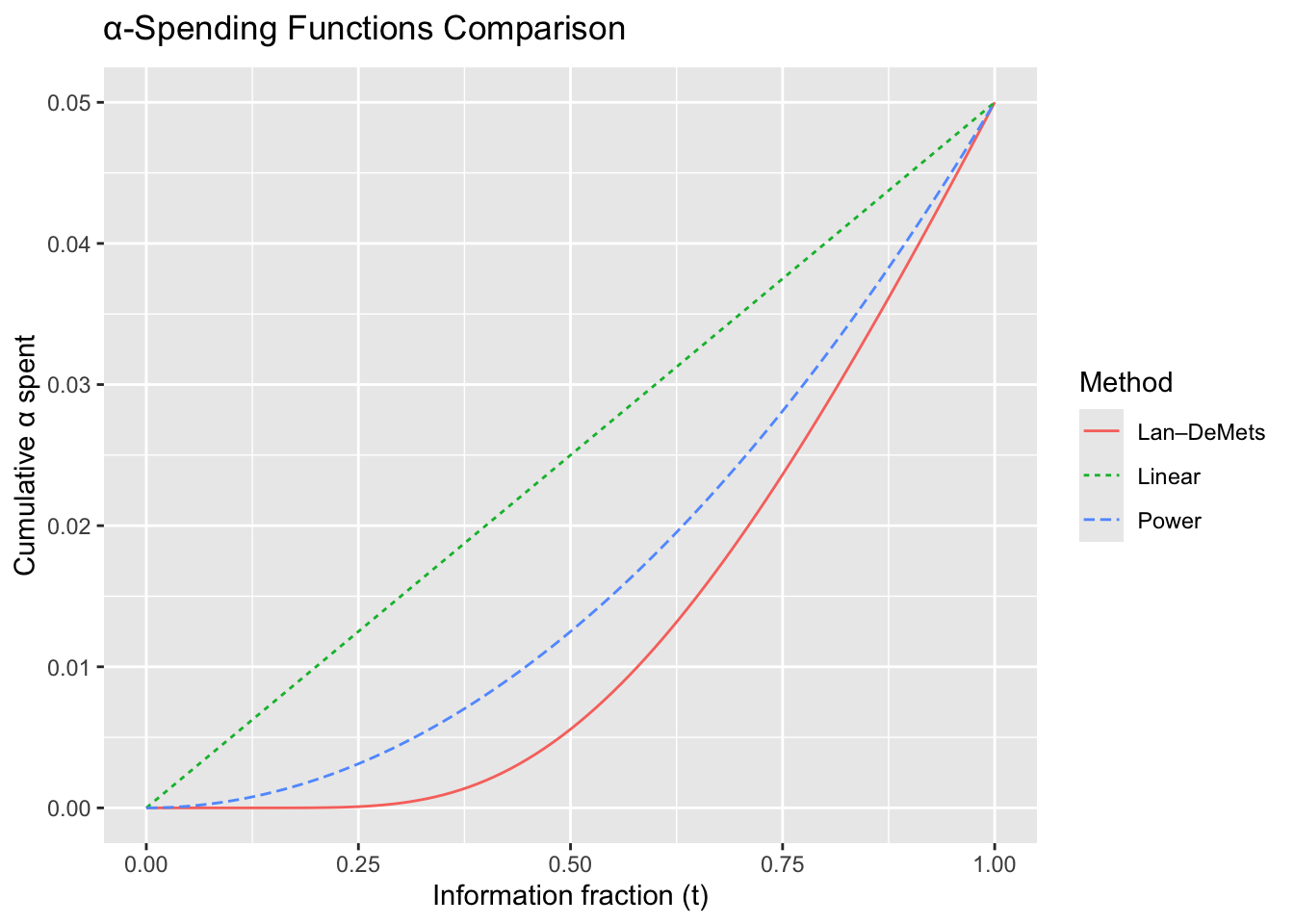
Suppose your total α = 0.05. If you test multiple times, you risk inflating your false-positive rate. The alpha-spending function ensures that the total probability of a false positive across all analysis stays ≤ 0.05. We define a cumulative α-spending function\(g(t)\) , where $t $ is the information fraction (e.g., 0.25 means 25% of total data collected). Some common choices of alpha-spending function include:
Type
Formula
Characteristics
Linear Spending
\(g(t)=\alpha t\)
uniform \(\alpha\) increase with information
Power Spending
\(g(t) = \alpha t^\rho\)
Flexible tuning
Lan-Demets
\(g(t)=2-2\Phi(\frac{z_{1-\alpha/2}}{\sqrt{t}})\)
Spends very little \(\alpha\) at first, liberal later
Here are some numerical examples for understanding (Total \(\alpha=0.05\))
The group sequential design is very flexible. The trial stops early if treatment clearly helps (or harms) to save time and money. It is scientifically rigorous to maintain Type I and Type II error control. However, researchers much pre-specify the number and timing for interim analyses. This type of design requires independent Data Monitoring Committee (DMC) to review interim results to avoid bias.
At the same time, sequential sample size recalculation can be done while adjusting the $\alpha$.
Sequential Adaptive Randomization
Sequential random allocation means that participants are assigned to treatment groups one at a time (sequentially as they enter the trial), using a randomization rule that may depend on previous allocations or outcomes. When patient $i$ enters:
Participants arriving later have higher probability to get A — ethically preferable if evidence accumulates.
Example: Play-the-winner Rule
Start an urn with 1 ball for A and 1 for B. For each patient: draw a ball and assign the patient to that arm. Update after outcome (typical “add-one-on-success” scheme):
If A succeeds: return the ball and add 1 A ball (future draws favor A).
If A fails: return the ball and add 1 B ball (shifts toward B), and vice-versa.